
Yes, we all know: implementing Gender Equality Plans is difficult, and very often obstacles and delays may be discouraging.
That’s why it’s so important, also for all LeTSGEPs’ teams, to share experiences and knowledge with colleagues and participate in interesting events. This is the case for example of the webinar organized by the H2020 project GRACE that took place online on November, 9th. During the event, experts discussed the challenges in developing Gender Equality Plans and showcased best practices in the field of Research Funding Organizations. Our colleague Rezarta Perri from University of Tirana participated to the webinar, and shared with us all the interesting issues that were discussed. Here is her report (Thank you very much, Rezarta!)
Research Funding Organizations (RFOs) represent a various landscape of various public and private, small and big entities that provide fundings, among other actors, to Research Performing Organizations (RPOs) as well. Their primary goal is to provide funding that will produce qualitative science by offering equal access and support for researchers and Research Performing Organizations.
The environment where RFOs and RPOs operate, in terms of Gender Equality, is changing rapidly either from internal dynamics, or due to new regulations and requirements enforced by regulators taking them towards a change in the role they play. An important topic recently has been the introduction and implementation of Gender Equality Plans, GEPs in the RFOs.
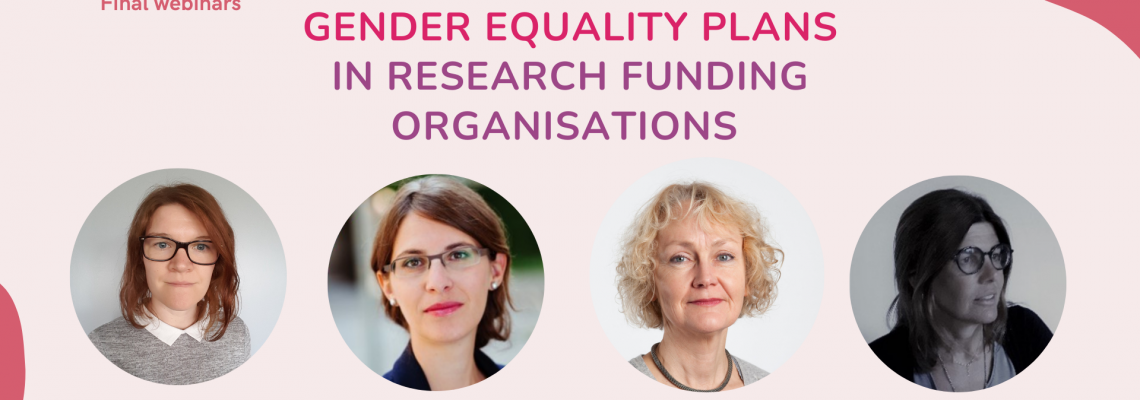
The Webinar on challenges in developing Gender Equality Plans in Research Funding Organizations, organized by GRACE[1] aimed to showcase best practices in this field, as well as to address the specificities of the RFOs in tailoring the GEPs, developing reliable tools to measure gender dynamics, and exploring how to better connect their internal and external activities supporting gender equality.
Various speakers – Dr Emer Cahill from Irish Research Council (IRC), GENDER-net; Lise Christensen from the Research Council of Norway; Donia Lasinger from Vienna Science and Technology Fund; and Cristina Borrás Sardà, from AGAUR – presented their ideas, and experiences, focusing on five important questions and topics that were identified and facilitated by the moderator Luciano D’Andrea from Knowledge and Innovation.
- Is there any standard model of GEP developed, and if so, what are the features or models of GEPs? Do these plans fit with the RPOs features?
- As the RFOs play a double role, by both trying to internally implement a GEP, but also requiring from RPOs they fund to have implemented a GEP, how do these two dimensions interrelate?
- What role does Gender Equality plays in Open Science in general, as Open Science approach sees gender equality as part of a broader policy including other issues (research ethics, public engagement, etc.)?
- What is to be said about the policy contexts as some of the RFOs are funded publicly, do GEPs have a role in policy environment or not?
- Where and how to start? What can be done at a policy level to promote GEPs?
Relating to the topic of whether a standard model of GEP exists, all the speakers agreed that while a specific model could not be provided (due to different needs and priorities different institutions need to tackle through their GEPs), they agreed that communication amongst various RFOs should continue to identify the best practices and develop a common template of GEP which could be helpful for RFOs that will try to implement GEPs in the future.
But is it possible to work externally (requiring GEPs from benefiting RPOs) without changing something internally at the RFOs? Difficulties, resistances, etc. are internal at each organization and they can start with raising awareness of the internal staff and changing organizational culture related to gender bias. Making GEPs mandatory is a positive step that pushes the RFOs in the right direction. Currently, as the presenters stated, many RFOs have gender policies in place, policies that could be extended and possibly converted into a GEP.
Again, what was mentioned was that it could be helpful to develop a GEP template and share best practices. Speakers all agreed that Gender Equality dimensions should be carefully included in the priorities of the RFOs and certain measures should be included in the RPOs applications for funding from the RFOs.
Another important topic recognized by the speakers was the inclusion of the administrative staff and managers in the development and implementation of the GEPs because this could further boost the process and guarantee a higher level of internal involvement.
As it was reported during the webinar, some RFOs have already decided to undertake the same measures and put forth the same requirements as EU for local funding (for example the case of the Research Council of Norway).
This webinar focused on discussions whether the RFOs are ready to implement GEPs or not. Do they have the internal structures, approaches etc. to implement GEPs? The speakers that represented various RFOs across Europe were in various stages in implementing GEPs and all recognised the challenges specifically related to building customized GEPs that reflect the internal features of each institutions. They all agreed that introducing and succeeding in implementing GEPs was something that should come from within an organization, but that could be facilitated by exchanging best experiences, trying to develop a common template and basic steps to follow and most importantly to keep the communication among RFOs open.
As one of the speakers nicely put during the webinar: “RPOs should fill the GEPs with life. Do not think about the GEP, live the GEP” – Donia Lasinger, Vienna Science and Technology Fund.
[1] The aim of the GRACE – Gender and Cultures of Equality in Europe project is to systematically investigate the cultural production of gender equalities within Europe. The GRACE project is providing advanced training for 15 early-stage researchers who are researching the production of cultures of gender equality across five specific sites where cultures of gender equalities are produced and contested by differently situated social agents