

On May, 30th, the LeTSGEPs consortium held the first of two Reflection Workshops. This Workshop addressed the topic of “Creating Sustainability of GEPs”.
The RWTH team, responsible for the monitoring and evaluation of the GEPs developed and implemented by the six Implementing Partners, presented their concept „Leverage points of GEP interventions“ for the explanation of system change through GEPs .
The concept was developed by theRWTH Team in accordance with the concept of leverage points discussed in sustainability studies. Cf. Joern Fischer and Maraja Riechers: “A leverage points perspective on sustainability. In: People and Nature, 2919:1; 115-120.
This approach allows GEP interventions to be assessed for its specific effectiveness and reach on organizational structure and culture.
The leverage points perspective (cf. Fischer and Riechers 2019)
– explicitly recognizes influential, ‘deep’ leverage points – interventions are difficult but likely to yield truly transformative change.
– enables the examination of interactions between shallow and deep system changes. Relatively superficial interventions may pave the way for deeper changes. Deeper changes may be required for superficial interventions to work.
– provides a common entry point for academics from different disciplines and other societal stakeholders to work together.
Prior to the workshop, the Implementing Partners were asked to discuss in their GEPs Working Groups the question: “What do you consider as important for implementing a gender equality plan sustainably in your organizations?”
The results of the discussion were then jointly discussed and located in the workshop based on the concept.
Figure: Leverage points of GEP interventions at LeTSGEPs partner institutions
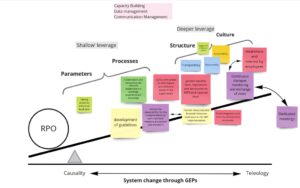
The figure mirrors the main discussion results. As ‘shallow leverage’ interventions were discussed such as having access to individual level data (although these are already difficult to obtain in some Research Performing Organisations), the development of guidelines or the collaboration and networking with different stakeholders within and outside the organization to exchange experience and knowledge.
As ‘deeper leverage’ interventions were discussed such as gender equality laws, regulations and structures on the organizational and national level or human resources and financial resources dedicated to the GEP implementation as examples for structural change. Examples of interventions with effect on cultural change were seen in the continuous dialogue, monitoring and exchange of view which produce awareness and interest by employees.
Overall, it can be noted that the majority of the interventions aimed at sustainability can be characterized as “deeper leverage” and addresses structural and cultural change within and outside the organizations.